Recognizing Peptide Purity Screening
Peptide Purity Guide 98%, 99% & Research-grade Discussed Prg
Trustworthy peptide testing laboratories will certainly provide a suite of contemporary logical techniques-- HPLC combined with MS is a must, and schedule of extra techniques like capillary electrophoresis or amino acid evaluation is a bonus. Be cautious of laboratories that do not use mass spectrometry alongside HPLC, as this could miss out on vital identity information. Likewise, prevent laboratories that can not demonstrate confirmed analytical approaches. In accordance with ICH guidelines, verified approaches mean the laboratory has actually established the test's precision, accuracy, detection limits, etc, making sure the information you obtain are dependable.Complementing HPLC, laboratories utilize Mass Spectrometry (typically combined as LC-MS) to confirm the peptide's molecular weight and series identity. Mass spectrometry gives molecular verification by finding the specific mass of the peptide and any type of co-eluting varieties or abbreviated sequences with high accuracy. With each other, HPLC and MS data enable experts to confirm that the peptide's make-up matches what it must be (appropriate amino acid sequence and anticipated modifications) and that no significant contaminants exist.
The most strict grade, including careful HPLC purification-- in some cases multiple rounds-- and extensive QC. Needed for quantitative researches, architectural biology, in vivo study models, and any application where also small amounts of impurity could affect outcomes. This is the grade where the boost most sharply, since achieving that last 1-- 3% of purity requires disposing of a substantial fraction of the manufactured material. A removal peptide missing out on a single residue might still bind to the very same receptor, but with different affinity or selectivity. In concentration-response experiments, these pollutants can move contours, flatten plateaus, or present biphasic habits that covers real activity of the target substance. The isoelectric factor (pI) is an essential criterion for understanding peptide solubility and behavior in various settings.Truncation And Fragmentation Items
Each peptide has a different expected molecular weight, so mass verification is not a common badge; it is compound-specific evidence. For a deeper identity-focused description, see Peptide Science Mass Spectrometry Peptide Verification. Identity testing validates that what was synthesized is in fact the intended series.- Peptides including methionine or cysteine residues are vulnerable to oxidation.
- For researchers, obtaining confirmed peptides isn't just a formality-- it's the structure of trustworthy experiments and research study reproducibility.
- For peptide pureness testing, reverse-phase HPLC is the conventional conceptual design.
- Peptides are delicate to temperature level, light, and chemical atmospheres, making them susceptible to deterioration, which affects efficiency.
The injector presents an accurate volume BPC-157 of example into the mobile-phase stream. Constant shot volume issues because overloading the column can widen optimals, distort pureness price quotes, or conceal neighboring contaminations. A strong peptide screening process utilizes methods that answer corresponding questions. The table below is the useful method to think of common examinations when reviewing a peptide COA.
Mass Spectrometry (ms): Identification Confirmation
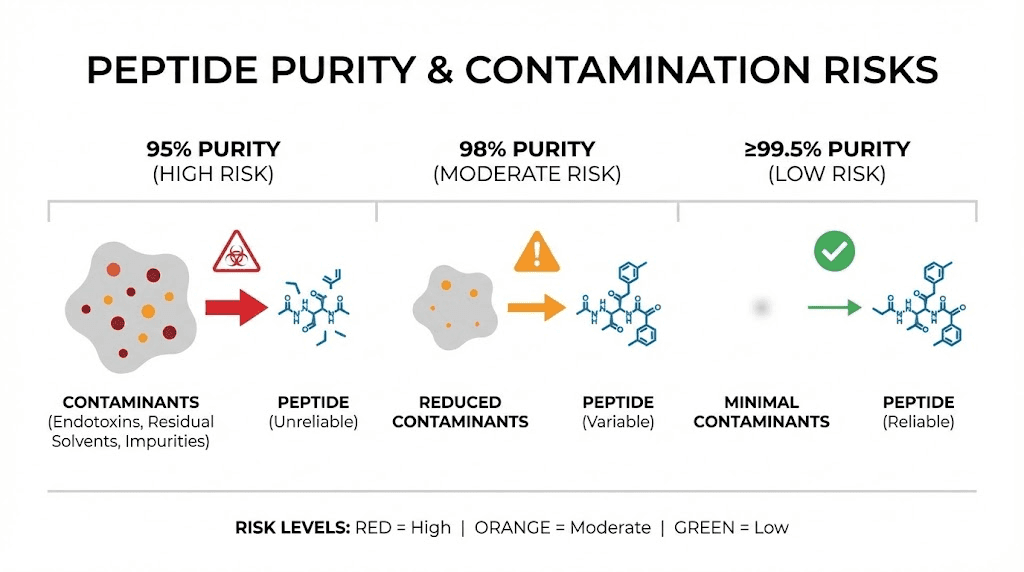
The purity of peptides is generally examined making use of high-performance fluid chromatography (HPLC). HPLC separates peptides based on their communications with a fixed stage, permitting impurities and by-products to be recognized and evaluated. Furthermore, mass spectrometry (MS) can be made use of to verify the peptide's molecular weight and sequence, supplying further confirmation of purity by finding contaminants and deterioration items. If you have actually ever before acquired an artificial peptide for a laboratory experiment, you've most likely noticed a pureness portion on the certification of evaluation-- typically worths like 95%, 98%, or even 99%. Peptide pureness is an important quality metric that tells you what portion of a peptide sample is the intended product versus undesirable by-products.
What Various Other Examinations May Add
As the percentage of organic solvent slowly increases throughout the run, particles are launched from the column in order of their hydrophobicity-- the extra hydrophobic a peptide, the longer it takes to elute (clean off). Given that impurities generally differ from the target peptide by a minimum of one amino acid, they have somewhat different hydrophobicities and show up as separate tops on the chromatogram. The key point is not to perplex purity (HPLC portion of the main peptide vs pollutants) with general content. For experimental planning (like determining molar concentrations), both pureness and web material work numbers, however pureness is what reflects the chemical homogeneity of the peptide example.